Distributed DALI lighting control

A fully distributed, IP-based architecture where every application controller is intelligent, resilient and part of a multi-master network. Start with a single controller and grow to tens of thousands of devices without redesigning the system.

controller icon

DALI application controllers

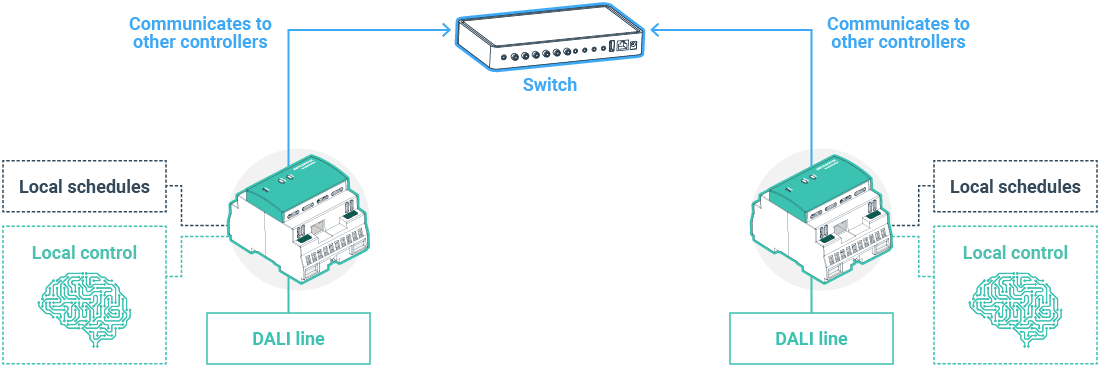
Each controller manages its own DALI line, schedules and logic locally. If the cloud or head end is offline, lighting continues to operate as programmed. Controllers communicate across the site, allowing any device to interact with others through the network.

Controller capabilities

  • Up to 64 DALI lighting devices per line
    (luminaires, relays and other loads)

  • Up to 64 DALI control devices per line
    (switch plates or sensors)

  • Up to 32 channels per control device
    (for example, a switch plate with 32 independent Buttons)

server icon

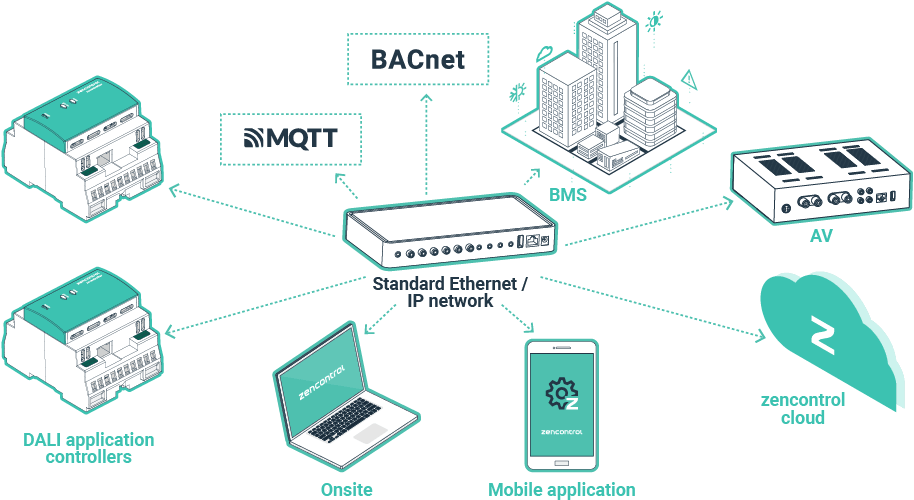
Standard ethernet / IP network

Application controllers operate as a multi-master system over standard IP infrastructure, creating a fully connected building. Existing IT switches can be used to share the network across floors, buildings and entire sites.

Connect and integrate with:

  • BACnet

  • MQTT

  • BMS platforms

  • AV systems

  • Other building services and gateways

cloud icon

Onsite head end & zencontrol cloud

Manage a single site or an entire portfolio with multi-user, multi-site access. Fine-grained permissions allow control down to an individual DALI line.

Key capabilities

  • Tenancy and floor management

  • Flexible access control

  • Analytics and emergency testing

Modern, distributed architecture by design

zencontrol is built as a fully distributed lighting control platform. Intelligence lives at the edge, coordination happens over standard IP, and the cloud adds powerful tools for management, analytics and multi-site operation.

At the heart of the system are DALI application controllers.
Each controller directly manages one or more DALI lines, including lighting devices, emergency fittings, relays, fans and other loads, as well as switches, sensors and input devices.

Every application controller:

  • Runs its own schedules, profiles and sequences for local, autonomous operation.
  • Stores configuration and behaviour on board, so lighting keeps working even if the cloud or network link is unavailable.
  • Communicates over standard ethernet using 10/100 Mbps ports compatible with typical IT switches and infrastructure.

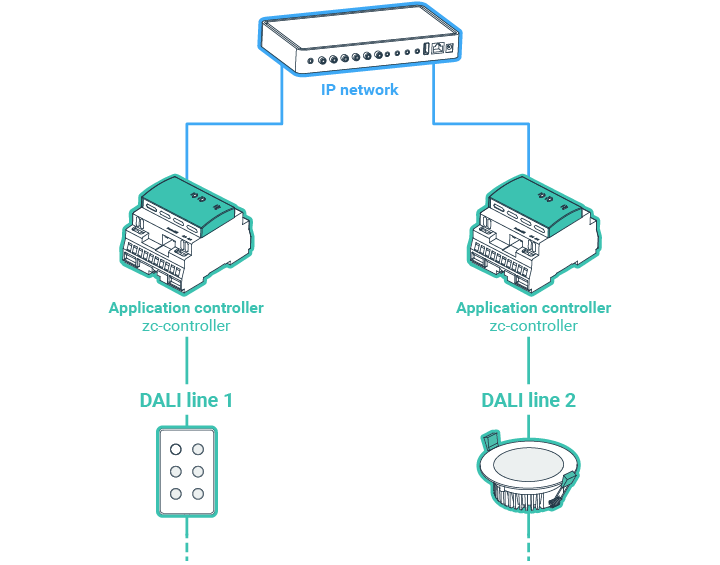
Multiple controllers are then linked on the same IP network, forming a multi-master control system where any controller can coordinate behaviour with any other. There is no single point of failure and no central “brain” that limits system size.

Because each DALI line is independent, you simply add more application controllers and lines to grow the system. There is no architectural limit to the number of lines you can aggregate via ethernet.

modern architecture illustration

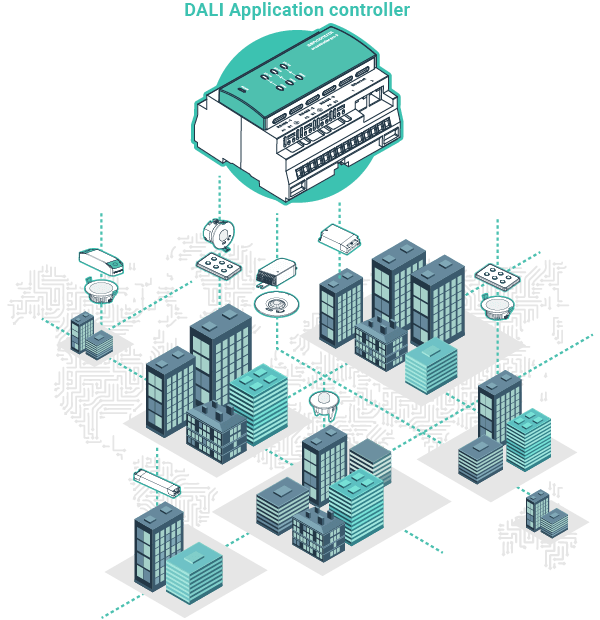
From single controller to tens of thousands of devices

Whether you are designing a small tenancy fit-out or a campus-scale rollout, zencontrol uses the same architecture. You scale by adding application controllers, not by redesigning the control system.

Start small.  Grow line-by-line.  Scale across sites & countries

A zencontrol system can start with a single application controller serving one DALI line. As requirements grow, you simply add more controllers and connect them to the same ethernet backbone. Each controller brings additional DALI capacity, and the cloud presents it all as one cohesive system.

In real projects, zencontrol is deployed on:

  • Small sites with one or two controllers, ideal for stand-alone rooms or individual tenants.
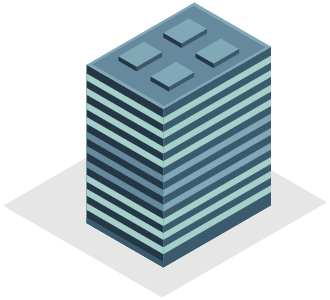
  • Large commercial buildings with hundreds or thousands of controllers.
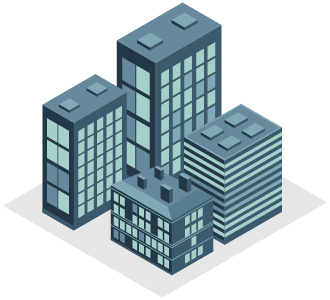
  • Very large estates where sites approach 50,000+ devices across many controllers, floors and buildings.

Because DALI is limited to 64 devices per line, zencontrol links multiple DALI lines together through the controllers and IP network, enabling practically unlimited capacity without compromising on control granularity or performance.

thousands of devices illustration

DALI done properly: capacity, structure and cross-line control

zencontrol maximises what is possible on each DALI line while making it simple to coordinate behaviour across lines, controllers, floors and buildings.

Per-line capacity

per line capacity

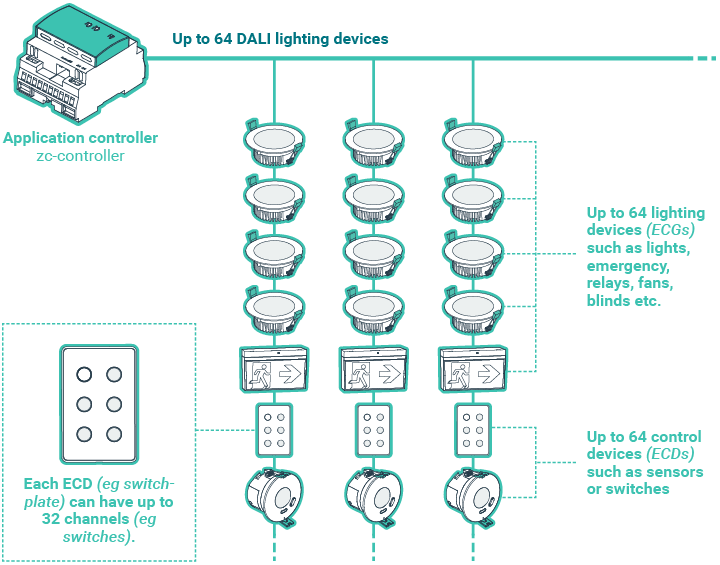
Each application controller manages its attached DALI lines with:

  • Up to 64 DALI lighting devices (ECG) per line – luminaires, emergency fittings, relays, fans and other loads.
  • Up to 64 sets of DALI control devices with upto 32 channels each (ECD) – switches, sensors and other inputs.

A single physical control device can expose multiple channels. For example, a 6-gang DALI switch plate counts as 6 independent switch channels, each of which can be programmed to control any fitting, group or zone in the system.

This structure keeps DALI wiring simple and predictable while still allowing very rich control logic, especially when combined with zencontrol’s profiles, triggers and sequences.

Beyond one line: multi-controller control

beyond one line

Switches and sensors are wired directly on the DALI line to their local application controller, but their effect does not have to stay local. Because controllers share information over ethernet, you can:

  • Use a switch on one DALI line to control lights and groups on any other controller in the same IP network.
  • Create external targets so dimming or scene changes propagate across controllers simultaneously.
  • Ensure LED indicators on switches stay in sync, even when multiple switches on different lines control the same area.

The result is a DALI system that behaves like a single, unified control platform, not a collection of isolated lines.
Distributed intelligence and true multi-master operation

zencontrol devices are designed as smart, multi-master nodes. Each controller can initiate control and respond to events, while staying perfectly in sync with its peers.

In traditional centralised lighting systems, a single server or head end handles most of the logic. If that server or its network link fails, control is disrupted.

zencontrol takes a different approach by placing intelligence at the edge:

  • Each application controller has its own time clock, schedules, profiles and sequences

  • Local functions — presence detection, time-based dimming, emergency testing — continue even without cloud connectivity

  • Controllers collaborate over Ethernet so scenes, zones and profiles can span multiple lines, floors and buildings

This ensures resilient, reliable control without dependence on a central brain.

Practical example: multi-way switching done right

multi master

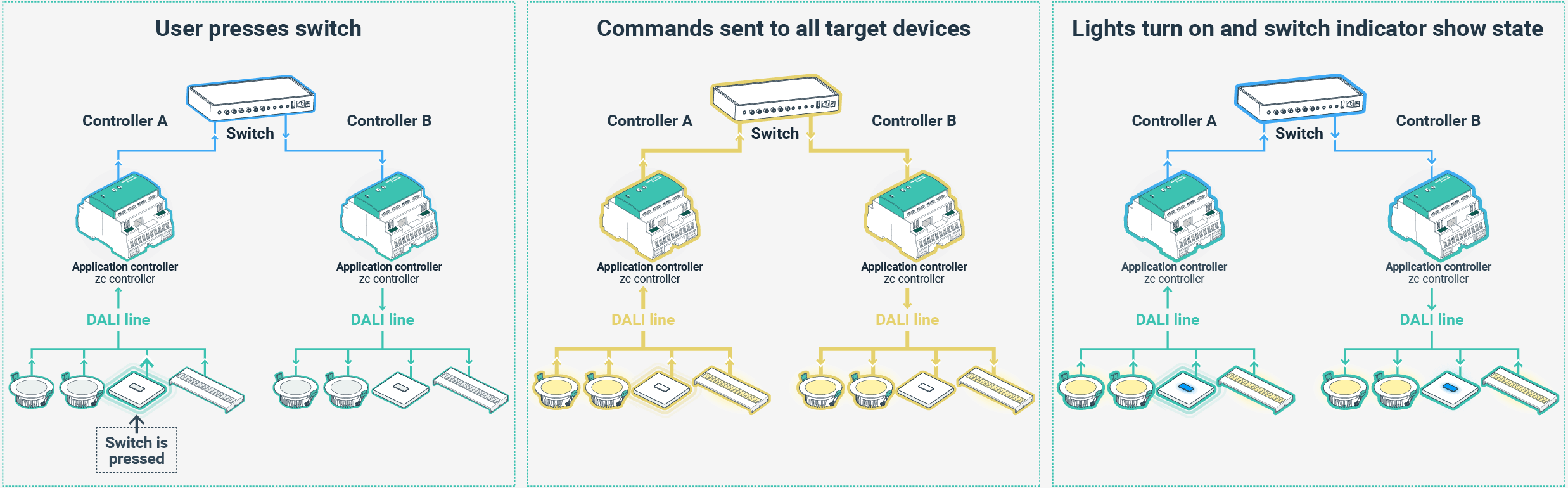
Consider a large open-plan office with switches at opposite ends and fittings spread across several DALI lines and controllers:

  • A user presses a switch on one line and lights on multiple controllers respond instantly

  • Switches on other lines detect the new state and update their LED indicators to match

  • If the cloud link drops, local behaviour and coordination between controllers continue as programmed

This is true multi-master operation: any device can trigger a change, and the entire system responds intelligently without relying on a single master controller.

Standard ethernet backbone, open integration and head end options

zencontrol is natively IP-based. Application controllers connect over standard ethernet, making it simple to integrate with other building systems and IT infrastructure.

standard etherrnet backbone illustration

Standard IT network, extraordinary capability

Each controller provides ethernet ports compatible with standard IT switches and routers. Lighting control shares the same structured cabling and switching fabric as other building services, reducing cost and complexity.

On that same IP network you can host:

  • BACnet-enabled BMS for HVAC, metering and broader building automation.
  • MQTT brokers and IoT platforms for analytics, dashboards and custom integrations.
  • AV and automation systems, including platforms like Control-4, via open protocols and gateways.
  • Other services such as KNX, DMX, RS-485 gateways and more.

By using industry-standard protocols, zencontrol avoids vendor lock-in and keeps your system flexible for future upgrades.

Onsite head end and connected cloud

On the same ethernet backbone you can deploy:

  • An onsite head end server for local management, BMS integration and on-premises workflows.
  • The zencontrol cloud connection, which uses the site’s internet link to provide secure remote access, analytics and multi-site management.

The cloud adds powerful capabilities:

  • Portfolio-wide, multi-site management from a single browser.
  • Full emergency test supervision and reporting.
  • Energy, occupancy, CO₂ and wellness analytics.
  • Centralised firmware management and feature upgrades for control systems and devices.

Importantly, the cloud enhances the system; it does not replace local control. The building continues to function if the internet link goes down.

Tenancies, floors, zones and fine-grained access control

Large buildings are rarely run by a single stakeholder. zencontrol’s cloud and software are designed to mirror how modern assets are owned, leased and operated.

Model the building the way it actually operates

A site can be broken down into logical layers:

  • Sites – individual buildings, campuses or facilities.
  • Tenancies – different tenants, business units or departments within a building.
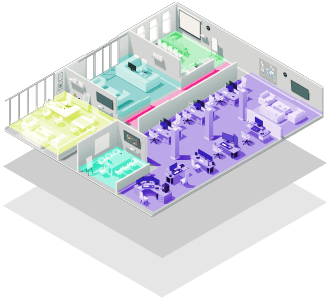
  • Floors, wings and zones – physical layouts such as levels, wings, meeting rooms and open-plan areas.
  • Groups and targets – logical groupings of fittings, such as open-plan zones, feature lighting, circulation and so on.

Devices are mapped to locations and zones, not just DALI addresses, so owners and tenants can work in terms of their spaces – “Level 12 South open-plan” – instead of low-level device IDs.

Multi-level user access control

zencontrol’s permission model lets you give each stakeholder exactly the right level of control:

  • Site owners – full administrators who can see and modify all settings, controllers and areas on a site.
  • Site members – operational users with access to day-to-day tools (schedules, scenes, analytics) within designated scopes.
  • Tenancy owners & members – users who can control and adjust only the areas within their tenancy, such as specific floors or suites.
  • Scoped permissions – restrict users to particular floors, controllers, groups or zones, all the way down to a single fitting if required.
Per-tenant scheduling Per-floor overrides Controller-level admin

The cloud also tracks changes and allows administrators to roll back unwanted adjustments, reducing operational risk when many users share access to the same system.

tenancies tower

Example: multi-tenant tower
The building owner has full visibility of all controllers and devices. Each tenant is given access to their leased floors only – they can adjust schedules, scenes and comfort settings without impacting other tenants or common areas..

tenancies campus

Example: campus portfolio

A facilities team manages multiple sites across a state or country. Using zencontrol cloud, they can compare energy, schedules and emergency status across all locations from one dashboard.
tenancies fitout

Example: fit-out project
During a fit-out, contractors are granted temporary access to commission and fine-tune the new areas. Once complete, their access can be revoked, while the tenant retains ongoing control.

Why choose zencontrol?

scalable icon

Scalable by nature
Built on DALI and standard IP networking, zencontrol scales linearly by adding controllers. From a single DALI line to buildings with thousands of controllers and close to 50,000 devices, the architecture remains consistent.

shield icon

Resilient & future-ready
Distributed intelligence means no single point of failure. With cloud-driven updates, analytics and integrations, the system evolves with your building over its entire lifecycle.

person icon

Designed for real operators
Tenancies, floors, zones, groups and detailed access control mean building owners, tenants and contractors can each work in the language and scope that makes sense for them – safely and efficiently.

Ready to design your next zencontrol project?

Talk to us about your next building or portfolio. Whether you are starting with a single tenancy or migrating a national estate, zencontrol provides a modern, distributed architecture that is built to scale.